
Seedance 2.5 for Korean Developers: Native Korean Audio, Local Context, and What It Actually Costs
Seedance 2.5 Korea guide: native Korean dialogue in one pass, four real test generations, measured API costs and the parameters that matter.

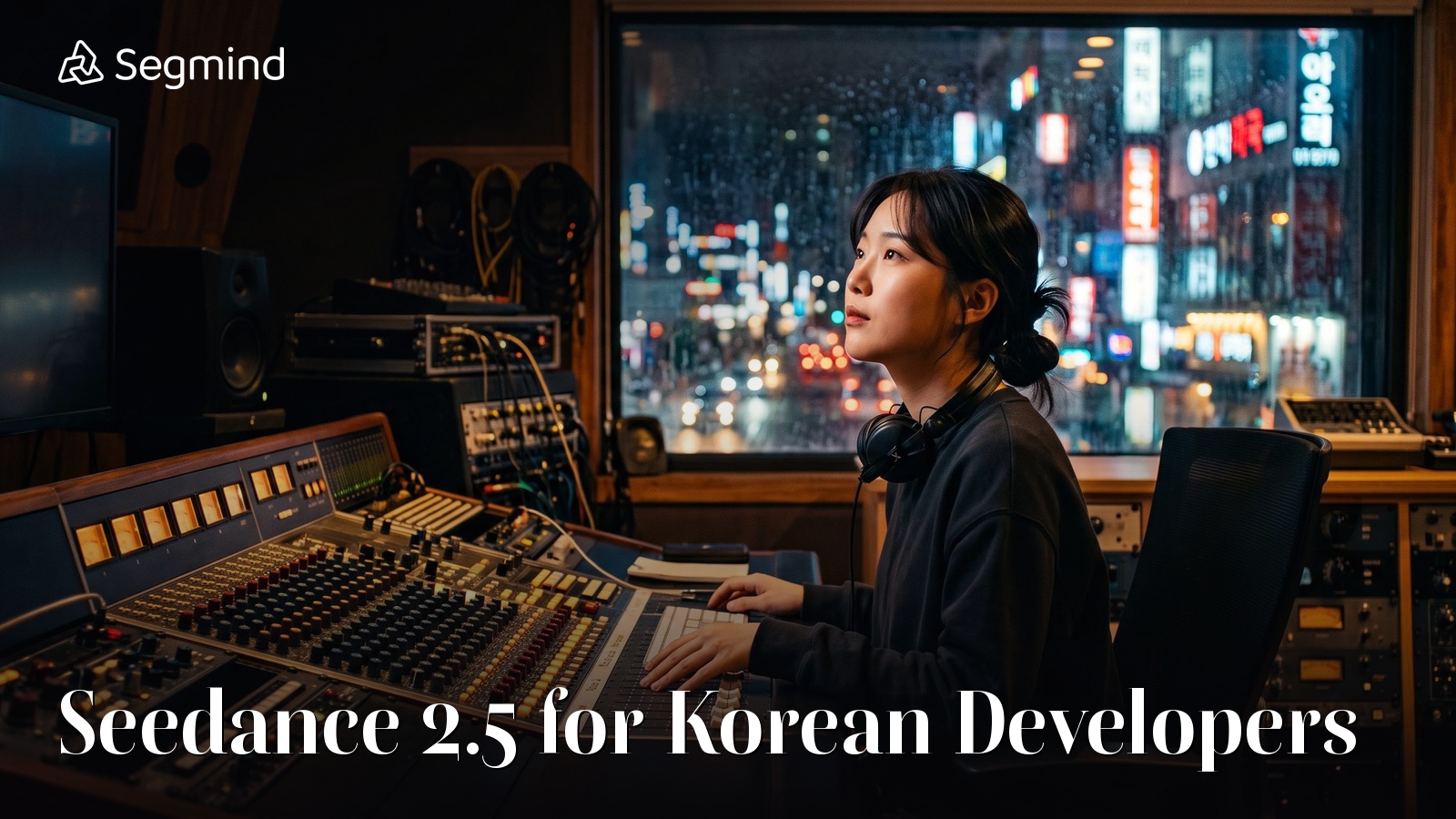
Every Korean-language video project I have worked on carried the same hidden tax: the dubbing step. You generate the visuals, then you go find a voice, record it, sync it, and hope the mouth shapes are close enough that nobody notices. That round trip costs more than the generation ever did.
Seedance 2.5 removes that step. Dialogue, ambience and lip movement come out of the same call that produces the picture. I spent an afternoon pointing it at Korean scenes specifically: a Hongdae street at night, a 2am convenience store, a K-beauty product shot, and a hanbok walk through Bukchon. Four generations, real API calls, real invoices. Below are the exact request bodies, the clips that came back, and what each one cost down to the fraction of a cent.
What Seedance 2.5 actually is
Seedance 2.5 is ByteDance's video model, served on Segmind at https://api.segmind.com/v1/seedance-2.5. Two things about the endpoint shape matter before you write any code.
It is synchronous. You POST, the connection stays open, and the MP4 comes back as raw binary in the response body. There is no job ID and no polling loop. That is pleasant to write against and slightly dangerous to deploy against, because a 15 second clip can hold that connection open for close to four minutes. Any default HTTP timeout you have lying around will fire first.
It generates up to 30 seconds in one pass, at 480p or 720p, with native audio. The audio is the interesting part for Korean work: you write the dialogue into the prompt in Hangul and the model performs it, rather than you bolting a voice on afterwards.
Here is the full parameter space, taken from the model's spec rather than from memory:
| Parameter | Type | Default | Notes |
|---|---|---|---|
prompt | string | required | Scene plus dialogue |
duration | integer | 5 | Range 4 to 30 |
resolution | string | 720p | 480p or 720p only |
aspect_ratio | string | 16:9 | 16:9, 9:16, 1:1, 4:3, 3:4, 21:9, adaptive |
generate_audio | boolean | false | Off by default. This is the one that catches people. |
first_frame_url | URL | none | Image to start from |
last_frame_url | URL | none | Image to end on |
reference_images | array | empty | Style and subject references |
reference_videos | array | empty | Extension and restyle inputs |
reference_audios | array | empty | Audio references |
seed | integer | 42 | Range -1 to 2147483647 |
bitrate_mode | string | standard | standard or high |
return_last_frame | boolean | false | Useful for chaining shots |
Note generate_audio defaults to false. If you are evaluating Seedance 2.5 for Korean dialogue and you leave that alone, you will get a silent clip and conclude the audio does not work. Set it explicitly, every time.
Four Korean test generations
I picked scenes that a Seoul studio or agency would plausibly bill for: street, retail, commerce, and heritage. Every call used 720p, generate_audio: true, and seed: 42. The Korean dialogue is written directly into the prompt.
1. Hongdae street at night, 15 seconds, 16:9
Two friends walking and talking, with the dialogue carried in the prompt:
{
  "prompt": "Night in Hongdae, Seoul. Neon hangul shop signs glow above a busy
  pedestrian street, light rain on the asphalt reflecting pink and blue. A young
  Korean woman in an oversized denim jacket walks beside her friend, holding a
  paper cup of coffee. She turns to him and says in Korean:
  '우리 저기 가볼까? 저 집 진짜 맛있대.' He laughs and answers:
  '좋아, 근데 줄 엄청 길어.' Handheld camera follows them at shoulder height,
  shallow depth of field. Crowd chatter and a distant street busker in the
  background. Photorealistic, natural night lighting, cinematic.",
  "duration": 15,
  "resolution": "720p",
  "aspect_ratio": "16:9",
  "generate_audio": true,
  "seed": 42
}2. Convenience store at 2am, 10 seconds, 9:16
The vertical format, because most Korean social video lives there. This one tests a short transactional exchange, the kind of line you actually hear in a CU or GS25:
{
  "prompt": "Interior of a Korean convenience store at 2am, bright fluorescent
  lighting, shelves stacked with ramyeon and snacks, a coffee cooler humming
  against the wall. A young male clerk behind the counter looks up as a customer
  sets down a bottle of banana milk. He scans it and asks in Korean:
  '봉투 필요하세요?' The customer shakes her head and answers: '아니요, 괜찮아요.'
  Vertical framing, close on the clerk's face then the counter, slight handheld
  drift. Quiet cooler hum and a soft door chime in the background.
  Photorealistic, documentary style, natural fluorescent light.",
  "duration": 10,
  "resolution": "720p",
  "aspect_ratio": "9:16",
  "generate_audio": true,
  "seed": 42
}3. K-beauty product reveal, 10 seconds, 9:16
A commercial case with voiceover rather than on-camera dialogue, which is how most beauty spots are actually cut:
{
  "prompt": "A glass serum bottle rotates slowly on a pale pink marble surface,
  soft studio light catching the liquid inside. A woman's hands lift the bottle
  into frame and unscrew the dropper. A warm female voice speaks in Korean:
  '피부가 진짜 달라졌어요. 아침저녁으로 한 번씩만 발라주세요.' Macro detail on
  the dropper and the texture of the serum, shallow depth of field, clean
  commercial product cinematography, soft ambient music. Vertical framing.
  Photorealistic.",
  "duration": 10,
  "resolution": "720p",
  "aspect_ratio": "9:16",
  "generate_audio": true,
  "seed": 42
}4. Bukchon hanok village, 15 seconds, 16:9
Heritage settings are where generic video models usually fall apart, mixing Korean, Chinese and Japanese architecture into something that looks wrong to anyone local. A useful stress test:
{
  "prompt": "Late afternoon in Bukchon Hanok Village, Seoul. Curved grey tiled
  roofs of traditional hanok houses against a warm autumn sky, a narrow stone
  alley running between the walls. A woman in a soft blue and coral hanbok walks
  slowly along the alley, her skirt moving with each step. She stops, looks back
  over her shoulder toward the camera and says quietly in Korean:
  '여기 오면 시간이 천천히 가는 것 같아요.' Golden hour light, slow dolly
  following her, gentle wind and distant birdsong. Photorealistic, cinematic,
  natural color grade.",
  "duration": 15,
  "resolution": "720p",
  "aspect_ratio": "16:9",
  "generate_audio": true,
  "seed": 42
}Play them with sound on. The dialogue, the ambience and the lip movement all came out of the single request body printed above each clip, with no dubbing pass and no audio editing afterwards.
What the four calls actually cost
These are billed amounts pulled from my account's request history, not estimates from a pricing page:
| Clip | Duration | Aspect | Billed | Per second | Latency | File size |
|---|---|---|---|---|---|---|
| Hongdae street | 15s | 16:9 | $3.564153 | $0.2376 | 224s | 19.2 MB |
| Convenience store | 10s | 9:16 | $2.379393 | $0.2379 | 81s | 10.0 MB |
| K-beauty reveal | 10s | 9:16 | $2.379393 | $0.2379 | 116s | 9.0 MB |
| Bukchon hanbok | 15s | 16:9 | $3.564153 | $0.2376 | 160s | 21.7 MB |
| Total | 50s | $11.887092 | ~9.7 min | 59.9 MB |
Three things fall out of that table.
Cost per second is flat. $0.2376 at 15 seconds versus $0.2379 at 10 seconds is the same number inside rounding. There is no volume discount for asking for a longer clip, and no penalty either. A 30 second generation should land near $7.13. Budget linearly and you will be right.
Aspect ratio is free. The two 10 second clips cost exactly the same despite one being vertical. Pricing tracks duration and resolution, not framing, so generate vertical natively instead of shooting 16:9 and cropping.
Latency tracks queue load, not duration. The two 10 second clips came back in 81 and 116 seconds. The two 15 second clips took 160 and 224. The spread between two requests of identical length is wider than the gap between 10 and 15 seconds, which tells you the wall clock is reporting on how busy the endpoint is rather than on anything in your request body. Do not put a duration-based progress estimate in front of a user, and do not assume a short clip comes back quickly.
One caveat on those latency numbers. I measured them from a server in the United States, so they include transatlantic transfer of a 20 MB file. A team calling the same endpoint from Seoul will see different numbers, and I have no way to measure that from where I am sitting. Treat the timings as an order of magnitude, not a benchmark for your region.
Calling it from Python
The whole integration is one POST and one file write:
import requests

resp = requests.post(
    "https://api.segmind.com/v1/seedance-2.5",
    headers={"x-api-key": API_KEY},
    json={
        "prompt": "... 인사말과 함께 카페로 들어서는 장면 ...",
        "duration": 15,
        "resolution": "720p",
        "aspect_ratio": "9:16",
        "generate_audio": True,
        "seed": 42,
    },
    timeout=600,          # not optional: see below
)
resp.raise_for_status()

with open("clip.mp4", "wb") as f:
    f.write(resp.content)   # raw MP4 bytes, not JSON
That timeout=600 is the single most important line. The default socket timeout in most HTTP clients is well under the four minutes these calls can take. Set it generously and set it explicitly.
The same call in cURL:
curl -X POST "https://api.segmind.com/v1/seedance-2.5" \
  -H "x-api-key: $SEGMIND_API_KEY" \
  -H "Content-Type: application/json" \
  --max-time 600 \
  -o clip.mp4 \
  -d '{"prompt":"...","duration":15,"resolution":"720p","generate_audio":true}'
Writing prompts for Korean dialogue
The prompt structure that worked across all four generations is consistent, and it is worth stating plainly because it is not the structure most people reach for first.
Write the dialogue in Hangul, not romanised. Every line above is written as '봉투 필요하세요?' rather than 'bongtu piryohaseyo?'. Romanisation asks the model to do a transliteration step before it does anything else, and that is a step where accent and intonation get lost.
Attribute the line explicitly. The pattern He scans it and asks in Korean: '...' ties the speech to a specific person performing a specific action. A prompt that just lists a Korean sentence with no speaker gives the model no anchor for whose mouth should move.
Match line length to duration. A conversational Korean sentence takes about two to three seconds to deliver naturally. The two-line exchanges above sit inside 10 and 15 second clips with room for the camera to establish the scene first and settle afterwards. Cramming four lines into a 5 second clip leaves no space for anything except talking heads.
Describe ambience separately from dialogue. Notice that each prompt ends with its own sound sentence: crowd chatter and a busker, a cooler hum and a door chime, soft ambient music. Keeping the background layer as its own short clause, rather than trying to specify sound effects per object, is the difference between a scene that sounds like a location and one that sounds like a recording booth.
Put the Korean specifics in the visual description too. Naming Hongdae, banana milk, hanok tiled roofs and hanbok does more for local authenticity than any language setting could. The dialogue makes it sound Korean, the production design makes it look Korean, and you need both.
Four practical notes before you ship
The MP4s are not web optimised. Every file came back with the moov atom after the mdat atom. In practice that means a browser has to pull most of the file before it can start playing, because the index lives at the end. If you are serving these directly to users, remux with ffmpeg -movflags +faststart first. It is a lossless container rewrite that takes about a second and meaningfully improves start time.
Durations are honoured precisely. I asked for 15 and 10 seconds and got 15.07 and 10.04. No silent truncation, no padding. You can cut to these in a timeline without checking.
Files are large. 720p at standard bitrate ran between 0.9 and 1.5 MB per second of video. A 30 second clip will land somewhere around 35 MB. Plan your storage and your CDN accordingly, and reach for bitrate_mode: "high" only when the extra weight earns its place.
Fire sequentially. I ran these four calls one after another rather than in parallel. Concurrent video generation from a single process has a habit of dropping requests silently, and because the endpoint is synchronous you will not have a job ID to reconcile against afterwards. Queue them.
Honest assessment
What Seedance 2.5 genuinely changes for Korean-language work is the shape of the pipeline, not just the cost line. Removing the dubbing round trip means the feedback loop on a script is a single API call, so you can iterate on wording in the morning instead of booking a booth for the afternoon.
What it does not do is give you control. There is no timeline, no way to adjust one line of dialogue without regenerating the whole clip, and no separate audio stem to hand to a mixer. At roughly $0.238 per second, every revision is a full re-render at full price, and revisions are where budgets actually go. For a 30 second spot that you expect to iterate on ten times, you are looking at $71 in generation before anyone approves anything.
My read: it is very strong for volume social content, product loops and previsualisation, where speed matters more than surgical control. For a hero campaign that will go through client rounds, keep a real edit suite in the loop and use Seedance for the boards.
FAQ
Does Seedance 2.5 support Korean dialogue natively?
Yes. You write the Korean line into the prompt in Hangul and the model performs it with lip movement in the same generation, with no separate dubbing or TTS step. Set generate_audio: true, since it is off by default.
How much does Seedance 2.5 Korea content cost to generate?
Roughly $0.238 per second of 720p output. My measured invoices were $2.379393 for a 10 second clip and $3.564153 for a 15 second clip. The rate is flat across durations, so a 30 second clip lands near $7.13.
What is the maximum video length?
30 seconds in a single call. The duration parameter accepts any integer from 4 to 30, and the default of 5 is much shorter than most people want.
Can I generate vertical video for Korean social platforms?
Yes, pass aspect_ratio: "9:16". It costs exactly the same as 16:9 at the same duration, so generate vertical natively rather than cropping a landscape render.
Why did my Seedance 2.5 clip come back silent?
generate_audio defaults to false. If you copy a minimal request body from a quickstart and do not set it, you get video with no audio track. This is the most common reason people conclude the audio feature is broken.
Do failed generations get charged?
Rejected requests that return a 4xx error bill at zero, so iterating on parameter constraints costs you latency rather than credits.
Where to go next
The fastest way to judge Seedance 2.5 for Korean work is to take one of the four request bodies above, swap the Hangul dialogue for a line from your own script, and run it. You will know inside four minutes and about $2.40 whether the voice is right for your brand.
The model page is at segmind.com/models/seedance-2.5, with the full parameter reference and a playground if you would rather click than curl. If you are building this into a pipeline, the synchronous endpoint and the generous timeout are the only two things that will surprise you.