
Seedance 2.5 Flash Tested: 35% Cheaper and 2x Faster Than Seedance 2.5
Seedance 2.5 Flash tested on 11 real clips: 35% cheaper and about 2x faster than Seedance 2.5 at 720p, plus where it slipped.

ByteDance shipped a cheaper tier of Seedance 2.5 and called it Flash. The pitch on the model page is simple: same multimodal model, same native audio, capped at 720p, about a third less money. I wanted to know what that third actually costs you in quality, so I ran it.
I fired eleven generations on Segmind: two head-to-heads where Seedance 2.5 Flash and Seedance 2.5 got the identical prompt and seed, a 480p vs 720p pair, and six tests of the features Flash claims to keep (image-to-video, reference images, vertical, a 20-second multi-shot scene, fast motion and a video edit). Every clip below is unedited output. Every price is the exact amount the API billed, not a page estimate.
Short version: Flash came back 34.6% cheaper per second and about twice as fast as Seedance 2.5 at 720p, and on my two matched prompts I could not call 2.5 the clear winner. Where Flash slipped, it slipped in ways 2.5 is also known for. Details, clips and the misses are below.
Seedance 2.5 Flash test results at a glance
| What I measured | Seedance 2.5 Flash | Seedance 2.5 |
|---|---|---|
| 10s clip, 720p, 16:9 (billed) | $1.598 | $2.443 |
| Render time, two 10s 720p clips | 88.5s and 76.2s | 166.3s and 175.3s |
| Resolutions | 480p, 720p | 480p, 720p, 1080p |
| Duration | 4 to 30s | 4 to 30s |
| Native audio, dialogue, lip sync | Yes | Yes |
| Output | H.264, 24fps, AAC stereo 32 kHz | H.264, 24fps at 720p |
| Total spent on this post | $18.49 across 11 clips and 2 input stills |
What is Seedance 2.5 Flash?
Seedance 2.5 Flash is the fast, economical tier of ByteDance Seed's Seedance 2.5 video model. It takes a text prompt, a first frame (and optionally a last frame), up to 10 reference images, up to 5 reference videos and up to 5 reference audio clips, and returns a 4 to 30 second MP4 with synchronized audio generated in the same pass. You can script beats with Shot 1:, Shot 2: labels, cite references inline as @Image 1 or @Video 1, and edit or extend an existing clip by setting duration to -1.
What it gives up is resolution. Flash stops at 720p. If you need 1080p you go to Seedance 2.5, and for native 4K there is a separate Seedance 2.5 4K endpoint. Everything else in the parameter list matches: aspect ratios from 21:9 to 9:16 plus adaptive, a seed, bitrate_mode, return_last_frame for chaining shots, and auto_resize for input images outside the accepted size range.
The model slug on Segmind is seedance-2.5-flash. It runs as a synchronous call on /v1 or a queued job on /v2, which is what I used for every test here because the status response carries the exact billed cost.
Seedance 2.5 Flash pricing, and the formula behind it
Flash bills per video token, and a token is a fixed slice of output pixels over time. The formula that matched all ten of my text and image runs to the cent:
frames = 24 x duration + 1
tokens = floor(width x height x frames / 1024)
cost   = tokens x $7.36841 per million   (text or image input, 480p or 720p)
Seedance 2.5 uses the same token count at $11.263141 per million for 480p and 720p, so Flash is 34.58% cheaper on every clip, at every length. Two details fall out of the formula. You pay for one extra frame on top of the duration you ask for, and aspect ratio only matters through pixel count, so 9:16 at 720x1280 costs exactly what 16:9 at 1280x720 costs. My vertical clip and my 16:9 reference clip both billed $1.279893 for 8 seconds.
| Clip (16:9, text or image input) | Flash 480p | Flash 720p | Seedance 2.5 720p | Seedance 2.5 1080p |
|---|---|---|---|---|
| 5 seconds | $0.36 | $0.80 | $1.23 | $3.02 |
| 10 seconds | $0.71 | $1.60 | $2.44 | $6.01 |
| 20 seconds | $1.42 | $3.19 | $4.88 | $12.00 |
| 30 seconds | $2.13 | $4.78 | $7.31 | $17.98 |
The 10 and 20 second Flash figures are what I was billed. The rest come from the same formula and the published per-million rates on each model's page. One small catch: the Flash page lists a 30 second 720p clip at $4.82, because it scales the 5 second price linearly. The formula says $4.78, since you only pay the extra frame once.
Reference videos are billed differently. A request with reference_videos switches to the video-input rate of $4.526309 per million tokens, and the reference footage is billed on top of the output. My edit test below took an 8 second source and returned 7.7 seconds, and it billed $1.536.
Test 1: dialogue and lip sync, Flash vs Seedance 2.5
Native dialogue is the feature I care most about, because it is the one that is hardest to fake in post. I wrote one line of speech, a specific action and a specific sound bed, and sent the identical request to both models.
Parametersduration: 10 | resolution: 720p | aspect_ratio: 16:9 | generate_audio: true | seed: 42
Seedance 2.5 Flash, $1.598, 88.5s
Seedance 2.5, $2.443, 166.3s
Same prompt, same seed, both at 720p. Unedited output with audio.
Both clips put the line in the same place, starting a little over six seconds in after the wheel spin, and both mouths track the words. I ran the audio through a speech recogniser to check the delivery rather than trusting my ears: Flash's take came back word for word, "Your spokes were loose, not broken, ten minutes, and you're riding." The 2.5 take was recognised less cleanly ("spokes" came back as "sphinx"), which is a mumble rather than a wrong line. Freewheel ticking, a wrench clink and street noise came through on both.
Both models made the same strange choice: they laid the wheel flat on the truing stand like a turntable instead of mounting it upright. That tells me Flash is not reasoning about the scene any differently from its parent. 2.5 dressed a busier shop with an open door to the street; Flash lit the scene warmer and pushed in more visibly. Flash's file was also the louder mix (-27.2 dB mean vs -32.0 dB), which saved me a normalising pass.
Test 2: a three-shot product ad, Flash vs Seedance 2.5
The second matched test was a 10 second cold brew spot in three labelled shots with set lengths of four, three and three seconds. It is the kind of thing a D2C team would actually brief, and it tests whether Flash respects shot timing.
Parametersduration: 10 | resolution: 720p | aspect_ratio: 16:9 | generate_audio: true | seed: 42
Seedance 2.5 Flash, $1.598, 76.2s
Seedance 2.5, $2.443, 175.3s
Same prompt and seed. Three shots requested at 4s, 3s and 3s.
I ran scene detection on both files. Flash cut at 3.75s and 7.21s, which gives shots of 3.75, 3.46 and 2.88 seconds against my 4, 3 and 3. Seedance 2.5 cut at 3.79s and 7.71s, so its final wide got 2.38 seconds. On timing, Flash was the more obedient of the two.
The action in shot 2 split them in an interesting way. Flash's hand placed the mint and then pushed the glass forward across the counter, which is what I asked for. 2.5's hand placed the mint and only gripped the glass. 2.5's closing wide is the nicer frame, with a barista clearly working the machine; Flash kept the barista in soft focus, which is also what I wrote. Neither invented a logo or on-screen text. If you showed me these two without labels, I would not be able to tell you which one cost 53% more.
Test 3: 480p vs 720p on the same seed
The model page suggests iterating at 480p and rendering finals at 720p. That is good advice for cost. It is bad advice if you expect the 480p clip to be a preview of the 720p one.
Parametersduration: 10 | resolution: 480p | aspect_ratio: 16:9 | generate_audio: true | seed: 42
Flash 480p (854x480), $0.711
Flash 720p (1280x720), $1.598
Same prompt and seed 42. Only the resolution changed.
The 480p render is a different take: a different woman, a sunlit street outside, a tighter push-in at the end. What carried over is everything the prompt actually named: the green apron, the pegboard, the line of dialogue at the same moment, the ambience. So use 480p to check that your wording produces the right beat and the right sound, at 44% of the 720p price, and expect the composition to re-roll when you step up. I have seen the same behaviour on Seedance 2.5, so it is a family trait, not a Flash shortcut. If you need to lock the look across resolutions, pin it with a first frame.
Test 4: image-to-video from a first frame
For this one I generated a still with Nano Banana 2 and passed it as first_frame_url. The aspect ratio has to be adaptive when you supply a first frame, and the output follows the image.
Input image
first_frame_url

First frame, generated with Nano Banana 2 (16:9).
Parametersduration: 8 | resolution: 720p | aspect_ratio: adaptive | generate_audio: true | seed: 42 | first_frame_url: image above
Seedance 2.5 Flash image-to-video. 8 seconds, returned at 1284x716, $1.277, 72.2s.
This is the strongest clip in the set. The propeller blurs, the floats push a clean wake, the plane lifts off and climbs into the mist, and the reflection on the water follows it the whole way. The dock and the mountains stay locked to the source image. The audio walks through an engine start, a roar and a fade as the plane leaves. With adaptive the output came back at 1284x716 rather than exactly 1280x720, and because the bill is pixel-based it cost a fraction less than a 16:9 clip. Note that ByteDance's policy blocks first frames with real human faces, so this path suits products, places and illustrated characters.
Test 5: holding a product with a reference image
Reference images are how you keep a product or character consistent without fixing the opening frame. I generated a plain product shot of a water bottle and cited it as @Image 1.
Reference image
@Image 1 (product)
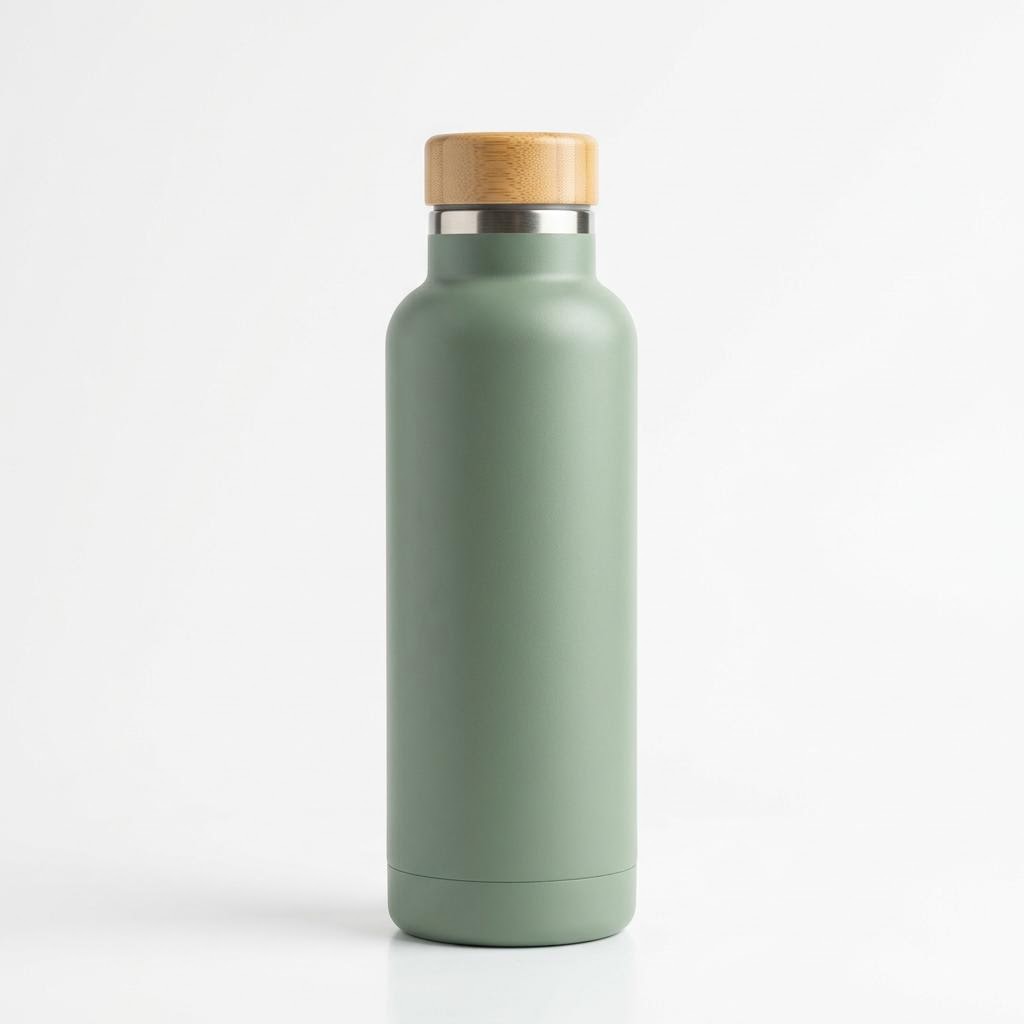
Reference product shot passed in reference_images.
Parametersduration: 8 | resolution: 720p | aspect_ratio: 16:9 | generate_audio: true | seed: 42 | reference_images: 1
Seedance 2.5 Flash with one reference image. 8 seconds, $1.280, 71.1s.
The bottle's shape, matte finish and steel ring carried over well, and the camera did exactly what I asked: close on the hands, a drink, then a pull back to a wide of the ridge. Two things drifted. The sage green shifted toward teal under the golden hour light, and the bamboo lid is never clearly shown. The bigger miss is that I wrote "her" and got a bearded man. When a product is the subject, Flash gives the reference priority over the rest of the prompt, so state any person you need twice and plainly. For a brand job, check colour on the first render before you batch.
Test 6: vertical 9:16 for social
Most short-form work ships vertical, so I ran a street food clip at 9:16. Same price as 16:9, because it is the same pixel count.
Parametersduration: 8 | resolution: 720p | aspect_ratio: 9:16 | generate_audio: true | seed: 42
Seedance 2.5 Flash at 9:16 (720x1280). 8 seconds, $1.280, 81.7s.
Batter spread, colour change, the fold and the slide onto the plate all happen in order inside eight seconds, with the sizzle and the spatula scrape on cue. It reads as phone footage, which is what I asked for. This is the clip I would show anyone who thinks a budget tier means visibly cheap output.
Test 7: a 20-second, three-shot scene with two lines of dialogue
Long single-pass generation is the headline feature of the 2.5 family. I asked Flash for 20 seconds in three shots with a line of dialogue from each character.
Parametersduration: 20 | resolution: 720p | aspect_ratio: 16:9 | generate_audio: true | seed: 42
Seedance 2.5 Flash, 20 seconds in one generation. $3.190, 133.2s.
Scene detection found cuts at 6.25s and 12.96s, so the shots landed at 6.3, 6.7 and 7.1 seconds against my 6, 7 and 7. The grandfather's line arrives in the first shot ("Wait for the wind. Now let go") and the girl's comes in the wide at about 13 seconds. Her line is quiet because she is a small figure in a wide frame, which is arguably correct sound design. The same girl and the same kite hold across all three shots. Twenty seconds of 720p video with dialogue for $3.19 is the number that makes Flash interesting for previs and micro drama drafts.
Test 8: fast motion, where Flash missed
I wanted one test designed to break it. A kickflip is a fast, specific, physically awkward action, and video models love to fake it.
Parametersduration: 6 | resolution: 720p | aspect_ratio: 16:9 | generate_audio: true | seed: 42
Seedance 2.5 Flash, 6 seconds. $0.962, 101.3s.
No kickflip. The skater pops onto the ledge, rides it in a manual and rolls off, and the board never rotates. The motion he does perform is clean, with no melting limbs or a board fused to his feet, and the one continuous low tracking move I asked for held with zero cuts. But it substituted an easier trick for the one I named. If your shot depends on a precise fast action, budget for retries, or test the same prompt on Seedance 2.5 before you commit. I did not fire 2.5 on this prompt, so I cannot tell you it would land it.
Test 9: editing a clip with a reference video
Flash can edit footage in place. I fed the vertical dosa clip back in as @Video 1 and asked for two changes.
Parametersduration: -1 | resolution: 720p | aspect_ratio: adaptive | generate_audio: true | seed: 42 | reference_videos: the 8s vertical clip from Test 6
Source (Test 6)
Edited, $1.536, 77.3s
Left: the source clip. Right: Seedance 2.5 Flash edit with duration -1.
The string lights switched from warm to blue throughout, and the vendor, his motion, the fold and the timing all stayed put. The banana leaf went wrong in an instructive way: instead of replacing the steel plate, Flash laid the leaf over the whole griddle, so the dosa is poured and cooked on a leaf. The model read "plate" as "the surface the food is on". Name the object by position and moment ("the steel plate the dosa lands on at the end") rather than by noun alone. The output was 7.7 seconds from an 8 second source, so allow for a slightly shorter return when you edit.
How fast is Seedance 2.5 Flash?
Every render time here is the server-side inference time from the job status, so it excludes my network and the download.
| Clip | Model | Render time |
|---|---|---|
| 10s 720p dialogue | Flash | 88.5s |
| 10s 720p dialogue | Seedance 2.5 | 166.3s |
| 10s 720p three-shot ad | Flash | 76.2s |
| 10s 720p three-shot ad | Seedance 2.5 | 175.3s |
| 10s 480p dialogue | Flash | 77.8s |
| 8s 720p (image, reference, vertical) | Flash | 71.1s to 81.7s |
| 20s 720p three shots | Flash | 133.2s |
| 8s 720p edit | Flash | 77.3s |
Across the two matched pairs, Flash averaged 82 seconds against 171 seconds for Seedance 2.5, so roughly 2x faster on the same work. Dropping Flash to 480p saved almost no time (78s vs 88s), so 480p is a cost lever, not a speed lever. Two runs is not a benchmark, and render times on this model family swing with load, but the gap was consistent in both pairs.
Seedance 2.5 Flash or Seedance 2.5: which should you use?
Use Flash for social and short-form work delivered at 720p or below, for ad variants and A/B creative where you need volume, for animatics and previs, and for any pipeline where a human reviews many takes and keeps a few. At $1.60 per 10 seconds and about 80 seconds a render, you can try twice as many ideas in the same afternoon for less money.
Use Seedance 2.5 when the deliverable is 1080p, when you need more than 720p detail for text or small faces, or when the reference set is the heavy part of the job. I would also test 2.5 for any shot built around a precise, fast physical action, though I have not proven it does better there.
What did not change between tiers was the prompting. The same wording worked on both, with the same habits: describe the sound bed and end it with "no music", put dialogue in quotes with "no subtitles", give each labelled shot a length, and say which object you mean by where it is and when it appears.
Seedance 2.5 Flash API quickstart
A minimal Python call on the queued /v2 endpoint. The completed status includes the exact cost, which is handy if you are tracking spend per clip.
import time, requests

KEY = "YOUR_SEGMIND_API_KEY"
H = {"x-api-key": KEY, "Content-Type": "application/json"}

job = requests.post("https://api.segmind.com/v2/seedance-2.5-flash", headers=H, json={
    "prompt": "A street vendor folds a crisp dosa on a black griddle at night. "
              "Sound: loud sizzle, spatula on steel, street chatter, no music.",
    "duration": 8,
    "resolution": "720p",
    "aspect_ratio": "9:16",
    "generate_audio": True,
    "seed": 42,
}).json()

rid = job["request_id"]
while True:
    status = requests.get(f"https://api.segmind.com/v2/requests/{rid}/status", headers=H).json()
    if status["status"] in ("COMPLETED", "FAILED"):
        break
    time.sleep(10)

result = requests.get(f"https://api.segmind.com/v2/requests/{rid}", headers=H).json()
print(status.get("metrics", {}).get("cost"), result["output"])
For image-to-video, add first_frame_url and set aspect_ratio to adaptive. For references, pass reference_images and cite them as @Image 1 in the prompt. For edits, pass reference_videos and set duration to -1. The full parameter list is on the Seedance 2.5 Flash API page.
FAQ
How much does Seedance 2.5 Flash cost?
On Segmind, Seedance 2.5 Flash bills $7.36841 per million video tokens for text or image input at 480p and 720p. In practice a 10 second 720p clip costs $1.60, a 20 second clip $3.19 and a 10 second 480p clip $0.71. That is 34.6% less than Seedance 2.5 at the same resolution and length.
Is Seedance 2.5 Flash faster than Seedance 2.5?
In my two matched tests it rendered a 10 second 720p clip in 76 to 89 seconds, against 166 to 175 seconds for Seedance 2.5 on the same prompt and seed. That is about twice as fast.
Does Seedance 2.5 Flash support 1080p?
No. Flash supports 480p and 720p only. For 1080p use Seedance 2.5, and for native 4K use the Seedance 2.5 4K endpoint.
Does Seedance 2.5 Flash generate audio and dialogue?
Yes. With generate_audio on (the default), it generates dialogue, effects and ambience in the same pass, and spoken lines in quotes come back lip-synced. Every clip in this post has native audio.
Does the same seed give the same video at 480p and 720p?
No. In my test the same prompt and seed produced a different take at each resolution. The named details carried over, but framing and casting changed. Use a first frame if you need the look locked.
Can Seedance 2.5 Flash edit an existing video?
Yes. Pass the clip in reference_videos, describe the change, and set duration to -1. Edits bill at the video-input rate, including the source footage, and my 8 second edit cost $1.54.
Verdict
I expected Seedance 2.5 Flash to be the draft tier, the one you use until the real render. After eleven clips I think it is the default tier for anything delivered at 720p. On my matched prompts it was as good as Seedance 2.5, sometimes more obedient, at 65% of the price and half the wait. Its misses, a substituted trick and a colour drift on a reference, are prompt problems you would also be solving on 2.5. Pay for Seedance 2.5 when you need 1080p. For everything else, start on Seedance 2.5 Flash.