
AI Image Gen Pricing Compared: Nano Banana 2 vs Seedream 5.0 vs GPT Image 2 (2026)
I measured real AI image gen pricing 2026: 11 API calls across Nano Banana 2, Seedream 5.0 Pro and GPT Image 2, with the exact billed cost of every image.

Every image model pricing page I read this year told me a number that was not the number I got charged. Not because anyone is lying, but because three of the most-used image models on Segmind right now bill on three completely different axes, and only one of them puts a per-image price in front of you.
So I stopped reading pricing pages and started reading invoices. I fired 11 real generations across Nano Banana 2, Seedream 5.0 Pro and GPT Image 2, same prompt on all three, and recorded the exact amount each one billed from the x-cost response header. Total spend: $1.63.
The results changed how I pick a model. One config in the matrix costs 34x more than another config on the same model at the same resolution. On GPT Image 2, asking for a bigger image made it cheaper. And the word "1K" means two completely different things depending on whose API you are calling.
Three models, three different meters running
Before any numbers, you need to know what each one is actually metering, because this is the whole reason budgets go wrong.
Nano Banana 2 charges a flat price per image, by resolution tier. 512px, 1K, 2K or 4K, with a small surcharge if you enable web search. Nothing else moves the price. You can read the cost of a job off the table before you run it.
Seedream 5.0 Pro charges a flat price by megapixel threshold. Under 2.36 MP of output is $0.05625, over it is $0.1125, plus $0.00375 for each reference image you pass in. Two tiers, one cliff edge.
GPT Image 2 charges by token, like a language model: $6.25 per million text input tokens, $10.00 per million image input tokens, $37.50 per million output image tokens. Nowhere on that page does it tell you how many output tokens a 1024x1024 image at quality: high actually produces. That number is the entire cost of your job and it is not published.
That is the practical split. Two of these models you can quote to a client in advance. One of them you cannot, until you measure it.
How I measured this
One prompt, run across all three models, deliberately chosen to be a real commercial brief rather than a benchmark: a product shot with brand text on it, the kind of thing a marketing team actually orders.
Parameters output_format: jpeg | Nano Banana 2 and Seedream at aspect_ratio 3:2 | GPT Image 2 by explicit size | resolution and quality varied per row
For every call I recorded the billed amount from the x-cost header, the wall-clock time, and then opened the returned file and measured its real pixel dimensions. That last step matters more than I expected.
What each image actually cost
Here is the full matrix. Every cost is measured, not estimated.
| Model | Config | Billed | Actual pixels | MP | Cost / MP | Time |
|---|---|---|---|---|---|---|
| Nano Banana 2 | 1K | $0.08000 | 1264x848 | 1.07 | $0.0746 | 12.2s |
| Nano Banana 2 | 2K | $0.12000 | 2528x1696 | 4.29 | $0.0280 | 17.7s |
| Nano Banana 2 | 4K | $0.16000 | 5056x3392 | 17.15 | $0.0093 | 28.5s |
| Seedream 5.0 Pro | 1K | $0.05625 | 1776x1184 | 2.10 | $0.0268 | 37.7s |
| Seedream 5.0 Pro | 2K | $0.11250 | 2496x1664 | 4.15 | $0.0271 | 48.0s |
| GPT Image 2 | 1024x1024, low | $0.00783 | 1024x1024 | 1.05 | $0.0075 | 14.5s |
| GPT Image 2 | 1024x1024, medium | $0.06633 | 1024x1024 | 1.05 | $0.0633 | 53.0s |
| GPT Image 2 | 1024x1024, high | $0.26388 | 1024x1024 | 1.05 | $0.2517 | 152.8s |
| GPT Image 2 | 1536x1024, medium | $0.05193 | 1536x1024 | 1.57 | $0.0330 | 38.0s |
| GPT Image 2 | 1536x1024, high | $0.20628 | 1536x1024 | 1.57 | $0.1312 | 104.8s |
| GPT Image 2 | 3840x2160, high | $0.50081 | 3840x2160 | 8.29 | $0.0604 | 109.0s |
First thing worth saying plainly: Nano Banana 2 and Seedream 5.0 Pro billed exactly what their pricing tables promised, to the cent, on every single call. $0.08, $0.12, $0.16, $0.05625, $0.1125. No markup, no rounding, no surprise. If you are building a cost model on those two, the published table is trustworthy and you can stop reading pricing pages defensively.
GPT Image 2 is where it gets interesting.
The GPT Image 2 token formula, solved
Because the billed amounts are exact, you can work backwards and recover the token counts. My prompt was a constant 53 text input tokens across every call, and every measured cost decomposes cleanly:
cost = (53 x $6.25/M) + (output_tokens x $37.50/M)
Solving for output tokens on each config gives round integers every time, which is how you know the model is right rather than merely close:
| Size | quality | Output tokens | Billed |
|---|---|---|---|
| 1024x1024 | low | 200 | $0.00783 |
| 1024x1024 | medium | 1,760 | $0.06633 |
| 1024x1024 | high | 7,028 | $0.26388 |
| 1536x1024 | medium | 1,376 | $0.05193 |
| 1536x1024 | high | 5,492 | $0.20628 |
| 3840x2160 | high | 13,346 | $0.50081 |
Two things fall out of that table that I would not have guessed.
1. The quality parameter is a 34x price lever
At 1024x1024, going from low to high takes you from $0.00783 to $0.26388. That is 33.7x the cost for the same number of pixels, and it also takes you from 14.5 seconds to 152.8 seconds. One parameter, quietly, is the single biggest cost decision on this model. If you inherited a codebase that leaves quality at its default of high and generates thumbnails, that is where your bill is going.
2. A bigger image can cost less
This one genuinely surprised me. At quality: high, a 1024x1024 image costs $0.26388 and a 1536x1024 image costs $0.20628. The larger image, with 50% more pixels, is 22% cheaper. The same inversion holds at medium: $0.06633 for the square, $0.05193 for the wider frame.
The square aspect ratio is the most expensive shape you can ask GPT Image 2 for, and 1024x1024 at high turned out to be the worst value in my entire matrix: $0.2517 per megapixel, which is 27x what Nano Banana 2 charges per megapixel at 4K, and the slowest call I made at over two and a half minutes.
If you take one operational thing from this post: on GPT Image 2, do not default to a square at high quality. Ask for 1536x1024 and crop.
"1K" does not mean what you think it means
I measured the actual pixel dimensions of every file rather than trusting the labels, and the labels turn out to be nominal.
| Label | Nano Banana 2 | Seedream 5.0 Pro |
|---|---|---|
| 1K | 1264x848 (1.07 MP) | 1776x1184 (2.10 MP) |
| 2K | 2528x1696 (4.29 MP) | 2496x1664 (4.15 MP) |
| 4K | 5056x3392 (17.15 MP) | not offered |
Seedream's "1K" is nearly double the pixels of Nano Banana 2's "1K", and it costs less ($0.05625 against $0.08). If you were choosing between those two on the label alone you would have made the wrong call in both directions at once.
And Nano Banana 2's "4K" is not 4K in the broadcast sense. 5056x3392 is 17.15 megapixels, which is more than double a true 4K UHD frame at 3840x2160. The tiers are linear multiples of the 1K base, so "4K" means four times the 1K edge length. For $0.16. That is the best pixel value in this entire comparison by a wide margin.
Does the expensive one actually look better?
Cost per megapixel is meaningless if the cheap pixels are ugly, so I looked at the files rather than assuming.
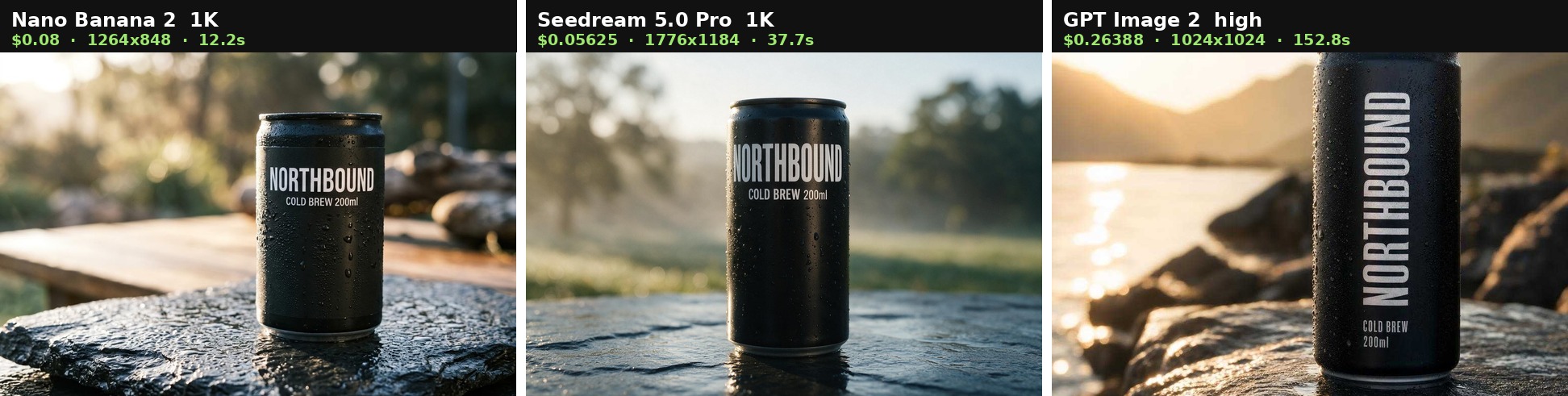
Same prompt, three models. All three rendered the brand text correctly.
All three nailed the brief, and all three rendered "NORTHBOUND" and "COLD BREW 200ml" correctly and legibly. Text rendering used to be the thing that separated these models. In 2026 it is table stakes at this price point.
The differences are in interpretation rather than competence. Nano Banana 2 gave me the warmest, most lifestyle-looking frame with a wooden bench and real backlight. Seedream 5.0 Pro produced the cleanest commercial hero, misty field, product dead centre, the one I would put straight into a catalogue. GPT Image 2 was the most dramatic, coastal sunset and rocks, but it chose to run the brand text vertically up the can rather than horizontally across it. Not wrong, but not what the brief said, and if you are matching an existing pack shot that is a re-roll.
Then the question that actually matters for your bill: how much does that 34x on the quality parameter buy you?
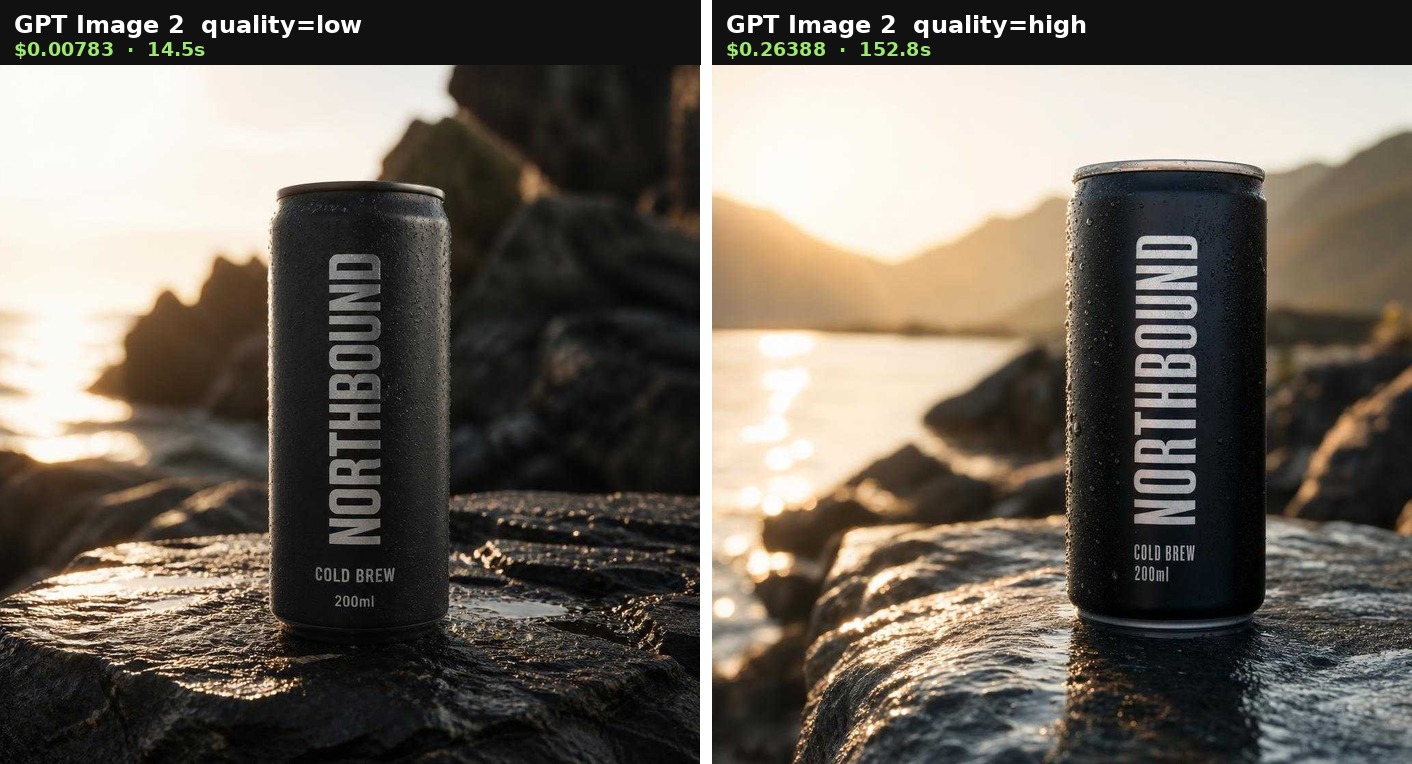
GPT Image 2 at 1024x1024. Left: quality=low, $0.00783. Right: quality=high, $0.26388.
Honestly? Less than the price gap suggests. At full size, high is genuinely better: crisper condensation droplets, cleaner specular highlights on the metal, sharper edges on the type. Pixel-peeping side by side, I can pick it every time. But at the size these images get delivered at, in a feed, in an email, on a product tile, low holds up far better than a 33.7x price difference implies.
My rule now is that high earns its money for a hero image that someone will look at closely or print. For volume work it is very hard to justify.
Which model I would pick for which job
High-volume social and performance creative. Nano Banana 2 at 1K or 2K. It was the fastest model in the test by a distance, 12.2 seconds at 1K against 37.7 for Seedream and 53 for GPT Image 2 at comparable settings, and the flat per-image price makes a campaign budget a multiplication rather than a guess. If you need dozens of variants, speed and predictability beat a marginal quality edge.
Ecommerce catalogue and print. Nano Banana 2 at 4K, $0.16 for 17.15 megapixels. Nothing else in this comparison is close on pixel economics, and 17 MP gives you room to crop hard for multiple placements from one generation. If you prefer the cleaner, more centred product framing, Seedream 5.0 Pro at 2K is $0.1125 for 4.15 MP and its composition was the most catalogue-ready of the three.
Work with reference images. Seedream 5.0 Pro takes up to ten reference images at $0.00375 each, which is close to free. Ten references add $0.0375 to a $0.1125 image. For brand-consistent series work where you are feeding in existing product shots, that is the cheapest way to stay on-model in this group.
When you specifically want GPT Image 2's look. Use 1536x1024 rather than a square, and treat quality as a budget decision made per job rather than a default. Its $0.50 4K render is also reasonable value at $0.0604 per megapixel, far better than its own square-at-high config.
Gotchas worth knowing before you commit
- The
qualitydefault on GPT Image 2 ishigh. That is the most expensive setting. Every call you do not explicitly configure is billing at the top of the range. - Latency and cost move together on GPT Image 2, hard. 14.5s at
low, 152.8s athigh. If you have a user waiting on a response,highis a product decision and not just a finance one. - Seedream's price cliff is at 2.36 MP of output, not at a resolution label. Cross it and the price doubles.
- Check the pixels you actually received. Both flat-rate models delivered slightly off-nominal aspect ratios: I asked for 3:2 and Nano Banana 2 returned 1.491:1. Fine for most work, worth knowing if you are compositing to a fixed template.
- Prices move. Everything here was measured on 8 September 2026. Re-measure before you build a long-lived quote on it.
FAQ
Which model is cheapest for AI image gen pricing 2026 comparisons?
GPT Image 2 at quality: low is cheapest both per image ($0.00783) and per megapixel ($0.0075), but that is its reduced-detail tier. Among full-quality configs, Nano Banana 2 at 4K wins on pixel economics at $0.0093 per megapixel, delivering 17.15 MP for $0.16.
Why did my GPT Image 2 bill not match the pricing page?
The page publishes a token rate, not a per-image price. Cost is 53 text tokens plus output image tokens at $37.50 per million, and output tokens depend on both size and quality in a non-linear way. A 1024x1024 image at high is 7,028 output tokens.
Is Nano Banana 2 or Seedream 5.0 Pro better value?
At the 1K label Seedream is better value: more pixels (2.10 MP against 1.07 MP) for less money ($0.05625 against $0.08). At 2K they are effectively tied on cost per megapixel. At 4K Nano Banana 2 has no competition here, and it was close to three times faster at both tiers they share.
Does a higher quality setting always mean a better image?
It means more detail, not necessarily a better result. GPT Image 2 at high resolves finer droplets and crisper type edges than low, but at typical web delivery sizes the gap is much smaller than the 33.7x price difference.
How can a larger image cost less on GPT Image 2?
Output token counts are not proportional to pixel count. A 1536x1024 image at high is 5,492 output tokens while a smaller 1024x1024 at high is 7,028. The square shape costs more despite having fewer pixels.
What does Nano Banana 2's 4K setting actually produce?
5056x3392, which is 17.15 megapixels, more than double a 3840x2160 UHD frame. The tiers are multiples of the 1K edge length rather than broadcast resolution standards.
The short version
If you want a number you can put in a budget before you run the job, use Nano Banana 2 or Seedream 5.0 Pro. Both billed exactly what their tables said on every call I made, and Nano Banana 2 at 4K is the best pixel value of any full-quality config here, roughly 3x better than the nearest one.
If you want GPT Image 2's particular look, go in knowing you are on a token meter with two settings that swing the bill by 34x, and that the obvious defaults, square and high, are the expensive corner of the grid. Ask for 1536x1024, set quality deliberately per job, and the model becomes reasonable.
The whole test cost $1.63. If you are about to standardise a team on one image model, an afternoon of measuring your own real prompts at your real output sizes is the cheapest procurement research you will ever do. You can run all three side by side on Segmind with the same API key.