
Seedance 2.0 vs HappyHorse 1.0: What Each One Is Actually Best At
A founder's hands-on comparison of Seedance 2.0 and HappyHorse 1.0 on Segmind: same six prompts, 10-second 720p clips, real costs, and where each model wins.

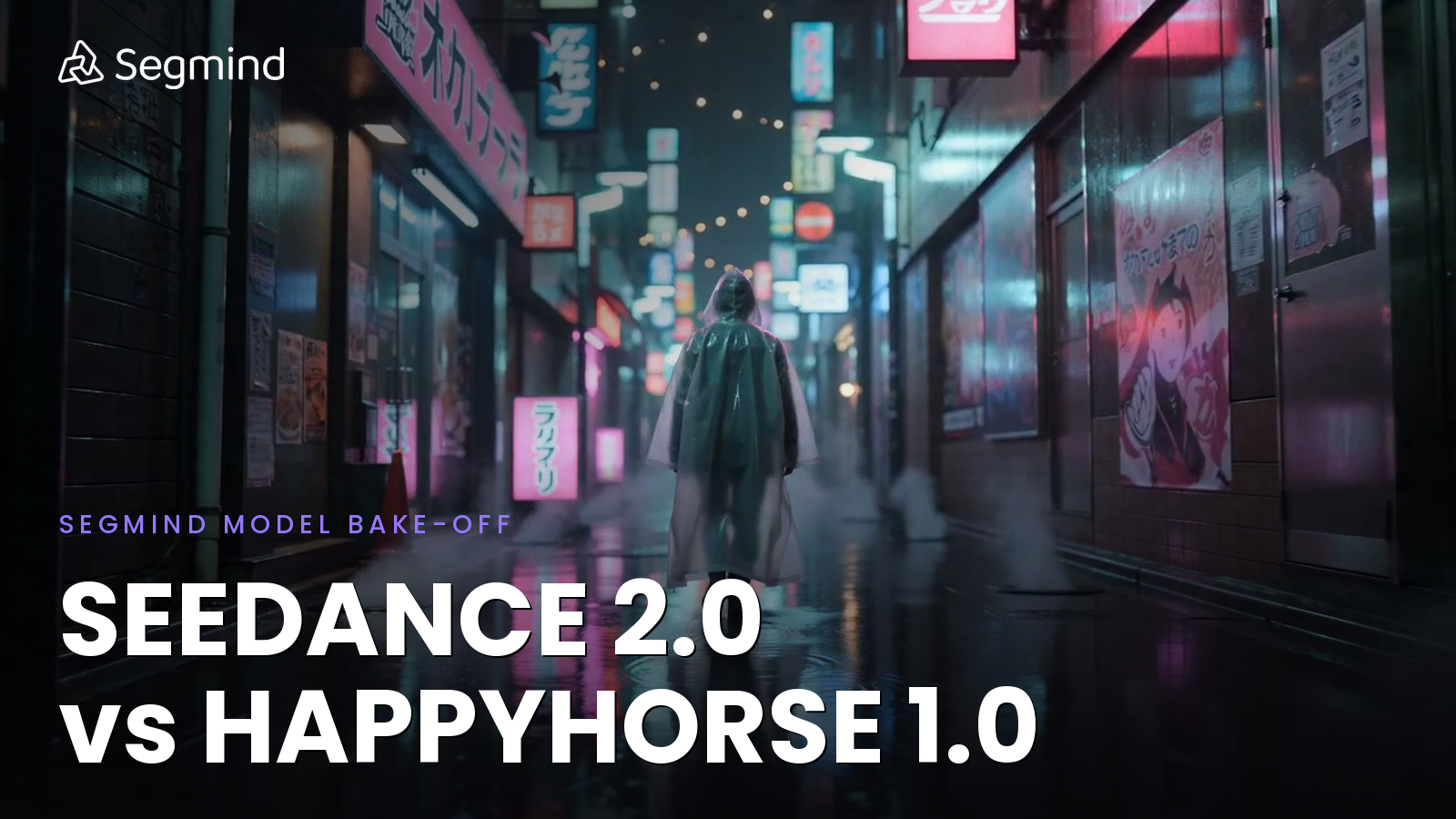
Two of the strongest video models on Segmind right now come from the two biggest names in the space: ByteDance's Seedance 2.0 and Alibaba's HappyHorse 1.0. Both generate video with native audio, both go up to 15 seconds, and both are good enough that the marketing copy starts to blur together. So instead of reading spec sheets, I ran them head to head.
I gave both models the exact same six prompts, generated every clip at 10 seconds, 720p and 16:9, then looked at the frames and listened to the audio side by side. Twelve clips, about 19.6 dollars of credits total. This post is what I found, including the cases where the winner surprised me. Everything here is reproducible on Segmind today.
The two models in one line each
Seedance 2.0 is ByteDance's native audio-video model built around multi-shot storytelling and omni-reference control, meaning you can steer a generation with reference images, reference videos and reference audio at once. It runs 480p, 720p and 1080p, supports wide cinematic ratios like 21:9, and lets you turn audio on or off per request.
HappyHorse 1.0 is Alibaba's 15-billion-parameter single-stream model. Its headline is synchronized audio plus lip-sync across seven languages (English, Mandarin, Cantonese, Japanese, Korean, German, French) produced in the same pass as the video, at true 1080p. At the time of writing it sits at or near the top of the Artificial Analysis Video Arena for both text-to-video and image-to-video.
How I tested
I wanted a fair fight, so the only thing that changed between the two models was the model itself: identical prompt text per pair, the same settings (10 seconds, 720p, 16:9, fixed seed 42), and six prompts chosen to stress different strengths. I submitted through Segmind's async API, then pulled start, middle and end frames from each clip and measured the audio levels. In each test below, the left video is Seedance 2.0 and the right is HappyHorse 1.0.
Test 1: Talking head and lip-sync
Parametersduration: 10 | resolution: 720p | aspect_ratio: 16:9 | audio: on
Seedance 2.0
HappyHorse 1.0
Left: Seedance 2.0. Right: HappyHorse 1.0. Same prompt, 10s, 720p.
Seedance held the character rock steady: same face, same framing, broadcast-clean from first frame to last, with a believable cafe behind her. HappyHorse pushed in tighter and put far more energy into the mouth, actively shaping words across the clip, which is exactly what its lip-sync engine is built for. The trade-off is that HappyHorse drifted a little more on identity as it animated. For talking avatars or spokespeople where the mouth must match speech, HappyHorse is the more convincing performer. For a stable, premium presenter shot, Seedance is the safer take.
Test 2: Motion and physics
Parametersduration: 10 | resolution: 720p | aspect_ratio: 16:9 | audio: on
Seedance 2.0
HappyHorse 1.0
Left: Seedance 2.0. Right: HappyHorse 1.0. Same prompt, 10s, 720p.
Both produced genuinely good fire. The difference was framing. Seedance went tight on the pan and the flare, almost like a food-commercial insert shot. HappyHorse kept the chef and the kitchen in frame and showed the toss as an action performed by a person in a space. For a recipe reel or a tight beauty shot, Seedance reads better. For a scene that needs the human and the environment to tell the story, HappyHorse composed it more usefully.
Test 3: Multi-shot narrative
Parametersduration: 10 | resolution: 720p | aspect_ratio: 16:9 | audio: on
Seedance 2.0
HappyHorse 1.0
Left: Seedance 2.0. Right: HappyHorse 1.0. Same prompt, 10s, 720p.
This is Seedance's home turf, and it showed. It cut cleanly from the wide establishing shot to the visor close-up to the low-angle flag plant: three distinct camera setups in one generation. HappyHorse also delivered three shots, and it nailed the hardest literal detail in the prompt, two separate moons reflected in the visor. If your work is built around sequenced storytelling and shot lists, Seedance gives you that structure natively. HappyHorse can follow a multi-shot brief too and reads literal details well.
Test 4: Cinematic control
Parametersduration: 10 | resolution: 720p | aspect_ratio: 16:9 | audio: on
Seedance 2.0
HappyHorse 1.0
Left: Seedance 2.0. Right: HappyHorse 1.0. Same prompt, 10s, 720p.
Both looked like film. Seedance matched the art direction more precisely: the teal and magenta grade was right there, the single raincoat figure was isolated with shallow depth of field, and the dolly move felt controlled. HappyHorse gave a richer, busier alley with more people and signage, and a slightly warmer grade than I asked for. If you are hitting a specific look board, Seedance respected the color and composition notes more faithfully. If you want atmosphere and density without micromanaging, HappyHorse is lovely.
Test 5: Prompt adherence with a specific action
Parametersduration: 10 | resolution: 720p | aspect_ratio: 16:9 | audio: off for Seedance
Seedance 2.0
HappyHorse 1.0
Left: Seedance 2.0. Right: HappyHorse 1.0. Same prompt, 10s, 720p.
This was the most interesting result. Seedance rendered the three objects cleanly but largely kept the scene static; the instructed action, a hand lifting only the blue mug, did not clearly happen. HappyHorse actually performed the action: a hand comes in from the right and grasps the mug. Its object layout was a touch looser, but for a prompt that hinges on a verb, HappyHorse did the thing I asked. This test also exposed a behavioral difference: Seedance honored audio off and produced no audio track, while HappyHorse always attaches one, here effectively silent at about minus 64 decibels.
Test 6: Ambient scene and native audio
Parametersduration: 10 | resolution: 720p | aspect_ratio: 16:9 | audio: on
Seedance 2.0
HappyHorse 1.0
Left: Seedance 2.0. Right: HappyHorse 1.0. Same prompt, 10s, 720p.
Both nailed this. Seedance leaned into a dramatic golden-hour backlight and a big breaking wave. HappyHorse gave lovely foam detail and multiple birds in the frame. On audio, HappyHorse was consistently louder and fuller across the whole test set, where Seedance sat quieter and more restrained. Neither is wrong; it depends on whether you want a mix you can drop straight into a timeline or a quieter bed you will balance yourself.
What each model is best at
Seedance 2.0 is strongest at: multi-shot sequences and shot-listed storytelling executed natively in one generation; faithful art direction (color grades, composition, shallow depth of field that match the brief); character and scene stability across the full clip; and pipeline flexibility (audio you can switch off, wide ratios like 21:9, and image, video and audio references together).
HappyHorse 1.0 is strongest at: lip-sync and talking-head delivery with active, speech-shaped mouth movement; carrying out specific actions described in the prompt; keeping the human and environment together in well-composed action scenes; and punchy, ready-to-use synchronized audio plus true 1080p output.
When to use which
| If you are making... | Reach for |
|---|---|
| Talking avatars, spokespeople, dubbed or multilingual dialogue | HappyHorse 1.0 |
| Short ads and stories built from multiple shots | Seedance 2.0 |
| Brand work that must hit an exact look board | Seedance 2.0 |
| Action clips where a specific motion has to happen | HappyHorse 1.0 |
| Social and UGC where audio should be baked in and loud | HappyHorse 1.0 |
| Silent video, or video where you will add your own sound | Seedance 2.0 |
| 1080p final delivery in a single pass | HappyHorse 1.0 |
| Reference-driven generation using image, video and audio together | Seedance 2.0 |
What it actually costs
| Model | Per 10s 720p clip | 6-clip total | Pricing model |
|---|---|---|---|
| Seedance 2.0 | about 1.52 | 9.11 | Token based, varies with content |
| HappyHorse 1.0 | 1.75 | 10.50 | 0.175/sec at 720p, 0.30/sec at 1080p |
For reference, HappyHorse at 1080p is 3.00 dollars for a 10-second clip. Both models came in comfortably under a 15 dollar per model budget for the whole six-prompt suite.
An honest assessment
This was a controlled bake-off, not a benchmark suite. I ran one generation per prompt at a single seed, so individual clips reflect one roll of the dice, not a guaranteed average. Across the six tests the strengths were consistent enough to trust the overall picture, but if you are choosing for production, generate two or three variants of your real prompt on both models before you commit. The good news is that both live on Segmind behind the same API, so swapping one for the other is a one-line change.
FAQ
Which model is better, Seedance 2.0 or HappyHorse 1.0?
Neither wins outright. HappyHorse is stronger for lip-sync, talking heads, specific actions and loud baked-in audio at 1080p. Seedance is stronger for multi-shot storytelling, precise art direction, stability and reference-driven control.
Do both models generate audio?
Yes, both produce synchronized native audio. Seedance lets you turn audio off per request, while HappyHorse always attaches an audio track.
Which one is better for lip-sync?
HappyHorse 1.0. Lip-sync across seven languages is its headline feature, and in my talking-head test its mouth movement tracked speech more actively.
What is the maximum clip length?
Seedance 2.0 supports 4 to 15 seconds. HappyHorse 1.0 supports roughly 2 to 15 seconds. I tested both at 10 seconds.
Can I get 1080p?
Both support 1080p. HappyHorse outputs true 1080p in a single pass at 0.30 dollars per second.
How do I switch between them?
Both are on the Segmind API. Call the seedance-2.0 endpoint or the happyhorse endpoint with the same kind of payload. Fetch the model's llms.txt first so you use the correct parameters.
The takeaway
If your work centers on talking, lip-sync or a specific action happening on screen, start with HappyHorse 1.0. If it centers on multi-shot storytelling, exact art direction or reference-driven control, start with Seedance 2.0. Both are excellent, both are a few dollars per ten-second clip, and both are one API call away on Segmind. Try them now: Seedance 2.0 and HappyHorse 1.0.