
Creative Workflow Management: 3 Use Cases + Tips for Studios
I built creative workflows for agencies, studios, and MCNs. Here's the system that actually ships work: modules, tools, and AI acceleration.

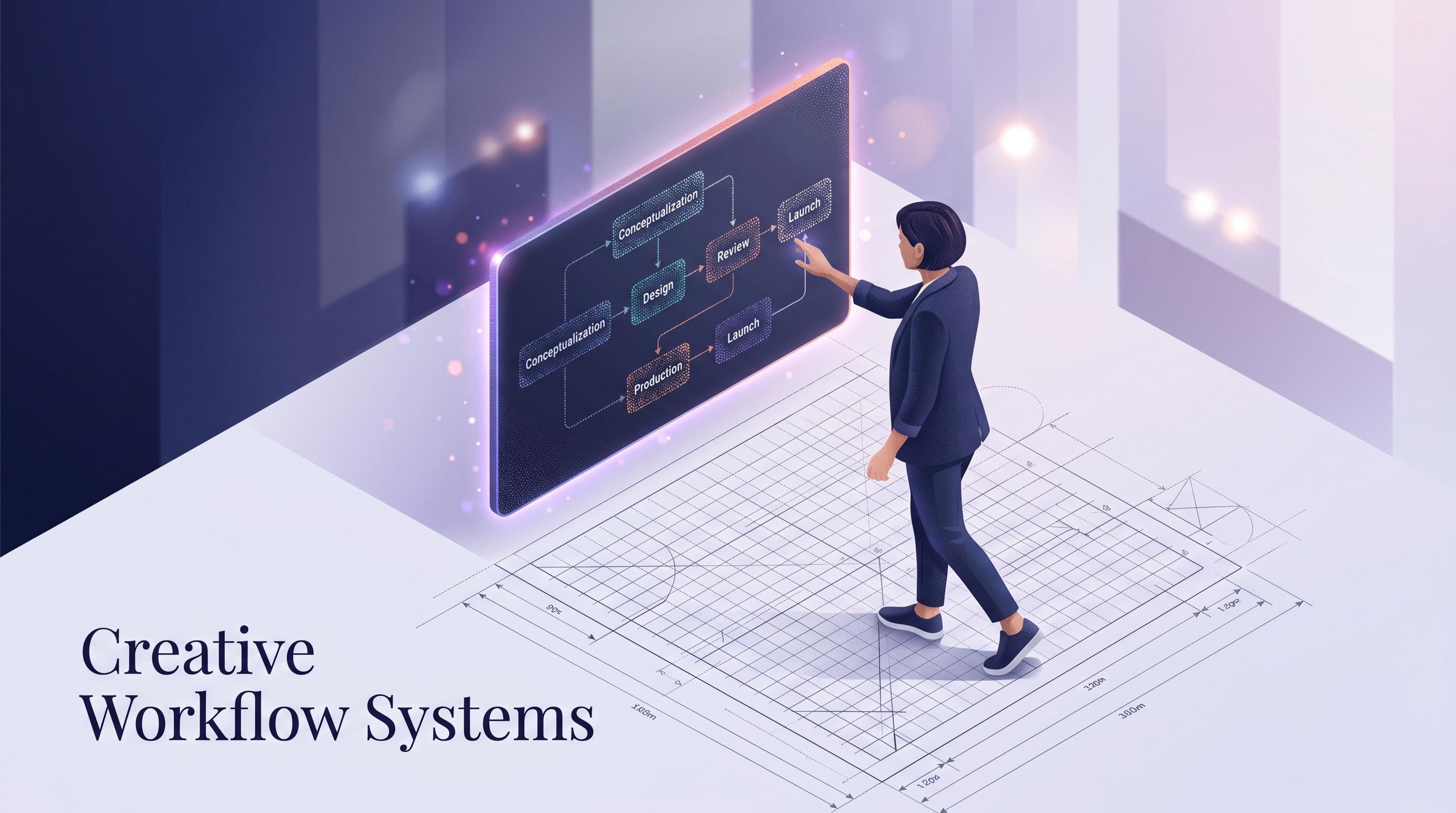
A few weeks ago, I sat on a call with the ops lead of a mid-sized marketing agency. She told me that her team of 14 creatives ships about 120 deliverables a week.
When I asked how much of their time goes into actual creative work, she paused and said, "Maybe 40%." The rest lives in Slack threads, version mismatches, missed approvals, and re-exports because someone changed the logo on page three.
That conversation is not unusual. Reports show that 58% of marketers spend nearly half their time managing reviews and approvals rather than creating content. Across the agencies, film studios, and production houses we talk to at Segmind, a consistent pattern shows up. The problem is rarely talent or tools. It is coordination. The fix is not another app. It is a deliberately designed creative workflow management system, built around how work actually moves through your team.
In this post, I want to walk through what that system looks like in practice, how the three industries we serve most often configure it differently, and where AI fits as a force multiplier without turning into a liability.
TL;DR
- Creative workflow management works when intake, production, review, asset storage, publishing, and reporting are integrated into a single, clear system, not spread across disconnected tools.
- The real drag on creative teams is usually coordination, version confusion, and approval sprawl, not a lack of talent or software.
- Agencies, film and VFX studios, and production houses all use the same workflow foundation, but each one configures it differently based on volume, review risk, and delivery needs.
- AI is most useful when it speeds up repetitive production work, such as ad variants, previs support, thumbnails, dubbing, and channel-specific outputs, while human judgment still decides what ships.
- The best way to build the system is to start with one repeatable deliverable, prove that workflow end-to-end, and then expand without overbuilding too early.
What is a Creative Workflow Management System?
At its core, a creative workflow management system is the operating layer that connects intake, production, review, asset storage, publishing, and reporting into a single source of truth. It is not a single piece of software. It is a set of connected modules with clear ownership and handoffs across the full journey of a creative deliverable.
The modules I see working well look like this:
- Intake and Brief: A structured form that captures the ask, deadline, brand constraints, and approvers before any work starts.
- Production: The tools where the actual asset is made: Figma, After Effects, Premiere, a Segmind PixelFlow workflow, a Nano Banana 2 prompt workflow, whatever fits.
- Review and Approval: A single place where stakeholders mark up, comment, and sign off. It should be asynchronous, timestamped, and auditable.
- Digital Asset Management (DAM): A canonical store for final assets with metadata, tags, rights, and version history.
- Publishing and Distribution: The handoff to distribution channels, such as ad platforms, social schedulers, editorial CMSs, and broadcaster delivery systems.
- Reporting: Throughput, cycle time, approval rounds, rework rate. Without this, you cannot tell if any of it is working.
What separates a good system from a cluttered one is not the number of features. It is that every deliverable has exactly one live location at every stage, and every stakeholder knows where to look. When I review systems that are failing, the root cause is almost always work spread across too many places.
The brief lives in email, the file lives in Drive, the comments live in a messaging app, and the approvals live in someone’s memory.
Use Case 1: Marketing Agencies Running at Scale
Marketing agencies often feel the pressure of creative workflow management first, because the unit economics are tight. If you promise a retainer client 50 ad variants a week, and each variant takes 3 hours of creative time plus 2 hours of coordination, the math doesn't add up.
The agencies we see operating most efficiently share three traits. First, their intake is templated and brand-scoped. Every new brief pulls from a brand kit with locked typography, palette, and tone guardrails, so the creative team never starts from zero, and the brand team never has to flag the same mistakes twice. Second, they automate variant generation.
Headlines, sizes, and language variations come out of a templated pipeline, not hand-exported from Figma one by one. Third, their approval chain is flat and parallel. Client, strategist, and QA review in parallel lanes rather than sequentially, compressing review cycles from days to hours.
This is also where generative AI becomes genuinely useful. A templated ad workflow can take a product image and prompt structure, then generate multiple variants across common aspect ratios such as 1:1, 4:5, and 9:16.
That can significantly reduce repetitive production work, especially when outputs flow straight into review and asset storage. A minimal call against a model like Nano Banana 2 looks like this:
import requests

response = requests.post(
    "https://api.segmind.com/v1/nano-banana-2",
    headers={"x-api-key": "YOUR_API_KEY"},
    json={
        "prompt": "Product shot of a matte black water bottle on pastel gradient, studio lighting, centered composition",
        "aspect_ratio": "1:1",
        "output_resolution": "2K",
        "output_format": "jpg",
    },
)

# The response contains the generated image (URL or base64, depending on setup)
result = response.json()
The important part is not that the API is simple. It is this call that lives inside the workflow, triggered by a structured brief, with the output flowing straight into the DAM.
The human does the taste and brand judgment, and the system does the repetition. If you want to test that kind of workflow in practice, a Segmind workflow template can help you prototype the generation step before you scale it across the wider production process.
Use Case 2: Film and VFX Studios
Film and studio workflows look different. The deliverable is heavier, the review cycles are longer, and mistakes become much more expensive once they move further downstream. A studio workflow management system has to handle three things that rarely show up in agency systems: pre-visualization, multi-vendor coordination, and long-form asset versioning.
Pre-visualization (Previs) is where I see the biggest lift from AI today. Previs has traditionally required specialized time, coordination, and iteration across multiple creative roles. Now, a combination of image generation for key frames and video generation tools can help teams create rough previs material much faster during early exploration.
That does not replace the real previs team. It does let the director and DP iterate on camera and blocking choices before anyone touches real production budget.
Multi-vendor coordination is often the operational core of the process. VFX, sound, music, and color are usually four different shops. A strong studio system gives external vendors the same brief, review structure, versioning rules, and approval visibility as internal teams.
The moment vendor feedback starts getting spread across emails and a shared Dropbox, review timelines become much harder to control.
For long-form versioning, the rule I use is ruthless: every export increments a version, every version is captioned with what changed, and only the latest is "live" in the DAM. Old versions stay accessible for rollback but are visually greyed out in every UI, so nobody picks up the wrong file at 2 am.
Use Case 3: Production Houses and MCNs
Production houses and Multi-Channel Networks each face distinct workflow challenges. They are running volume: a mid-size MCN might be pushing five hundred to a thousand videos a month across dozens of creators. The system has to optimize for throughput without losing platform-specific quality.
The pattern that works here is a split between a master cut and channel-specific variants. A creator or producer uploads a master once. The system then fans out platform-specific renders: 9:16 cut with hook-forward subtitles for TikTok, 1:1 with outro card for Instagram, 16:9 with chapters for YouTube, audio-only for Spotify.
Each variant is a derivative of the master, versioned against it, so late edits to the master can flow into downstream renders without manual rework.
Generative AI shows up here mostly in post-production acceleration. Auto-cutting highlights, generating thumbnails at different contrast and hook levels, and dubbing or translating the voice into additional languages.
A production house I talked to last quarter cut their thumbnail testing cycle from three days to three hours by moving from "designer makes four options" to "system generates twenty, producer picks four, A/B test the top pick." The creative judgment stayed human. The mechanical work went to the machine.
Where Segmind Fits in a Creative Workflow Management System
Segmind is the generative AI layer that plugs into these systems. We support hundreds of image, video, audio, and speech models through our APIs and workflow tools, so the workflow system does not need to be rebuilt every time the best model for a job changes, whether that is Seedream 5.0 Lite, Nano Banana 2, Veo 3.1 Lite, or a custom PixelFlow workflow.
You call the relevant model or workflow endpoint, get an output, and route it into the next stage of the asset pipeline.
Two properties matter when you are building a creative workflow management system. First, model choice should be decoupled from the rest of the workflow logic. When a better model becomes available, you should be able to swap it at the model layer without rewriting the intake, review, or approval flow.
Second, cost and latency need to be visible enough to support planning. Segmind’s model catalog surfaces pricing, latency, and capability details for public models, which makes budgeting and workflow design easier.
If you are in early design mode, the path I recommend is this: previews start with one high-friction deliverable, whether that is ad variants, thumbnail generation, or previs frames. Prove the workflow end-to-end on that one loop, then expand. Systems that try to cover everything on day one often become harder to ship and maintain.
Interested in testing how AI can enhance your creative workflows? Try Segmind’s PixelFlow workflows to accelerate production.
Common Creative Workflow Management Mistakes
A few things I wish people had warned me about earlier. Integration debt is real. Every module you add is another auth token, another rate limit, another failure mode. Budget for the glue, not just the headline tools. Second, a human-in-the-loop approach is not optional for anything client-facing. AI generates candidates. People select, edit, and take responsibility for what ships. Third, reporting has to be built in from day one, or it never gets built. If you cannot answer, “How long does a deliverable take on average?” in under a minute, your system is flying blind.
FAQs
What should a team fix first in a broken creative workflow?
Start with the point where work gets delayed most often. For some teams, that is intake, for others, it is approvals, asset handoff, or reporting. Fixing one repeatable pain point first is usually more effective than redesigning the entire workflow at once.
What tools should a creative workflow management system include?
At minimum: intake form, production tools, async review surface, digital asset manager, publishing integrations, and a reporting layer. Generative AI plugs into production and post-production.
How does AI fit into creative workflow management?
As an acceleration layer. AI generates candidates for variants, previews , thumbnails, dubs, and translations. Humans decide what ships. The workflow keeps AI outputs versioned and attributable.
How do you start building a creative workflow management system?
Start with one repeatable deliverable, such as ad variants, thumbnail generation, or previs frames. Map how it moves from brief to publish, then automate the most repetitive step first. Once that loop works, expand one part of the system at a time, such as intake, review, asset storage, or reporting, instead of trying to design everything up front.
Can one system work for agencies, studios, and production houses?
The modules are the same. The configuration is different. Agencies optimize for variant volume, studios for version safety, and production houses for channel fan-out. Same bones, different settings.
Conclusion
Creative workflow management works best when the system is designed around how work actually moves, not around a stack of disconnected tools.
The teams that get this right spend less time chasing approvals, fixing version confusion, and repeating manual production work, and more time moving strong creative through the pipeline with control. Start with one deliverable, prove the workflow, and expand from there.
If you want to see how that can work in practice, explore Segmind’s model catalog and PixelFlow workflows to test where AI fits into your production system.