
Segmind vs Higgsfield: Which AI Video Platform Is Built for Professionals?

The AI video generation landscape has matured rapidly. Platforms like Higgsfield and Segmind both give you access to the latest models include Veo 3.1, Kling 3.0, Seedance 2.0, and more. But beneath the surface, they're built for fundamentally different users.
Higgsfield is designed for prosumers who want polished presets and a guided experience. Segmind is designed for professionals - agencies, studios, brands, and developers who need control, custom workflows, and API-first integration.
This guide breaks down where each platform excels and which one fits your workflow.
The Core Difference: Presets vs. Canvas
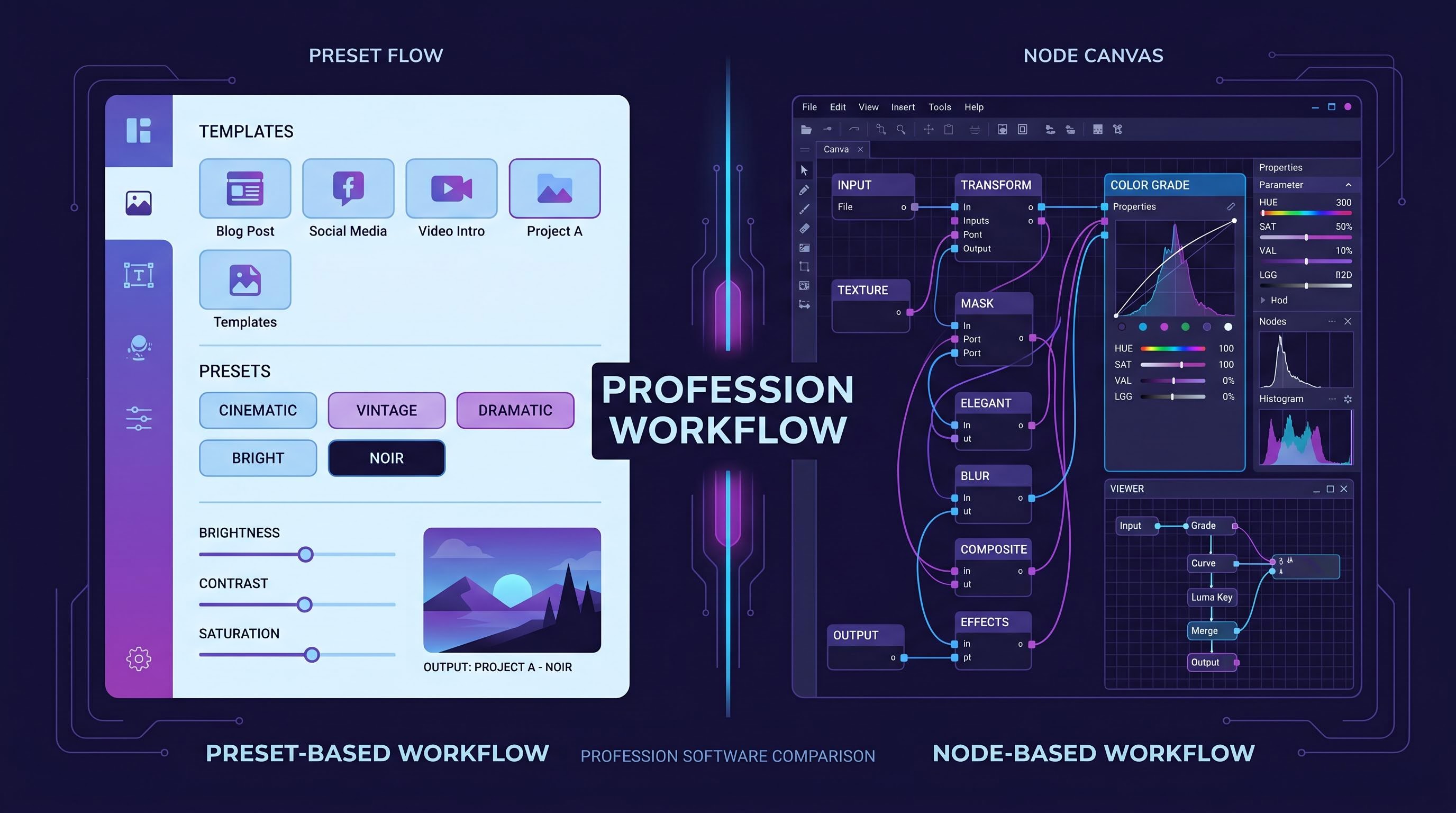
The easiest way to understand these two platforms is through a simple analogy. Higgsfield gives you a well-stocked toolbox with 40+ creative tools, each designed for a specific task — face swap, background removal, upscaling, lipsync. You pick a tool, feed it inputs, and get results. Their Cinema Studio offers 70+ cinematic camera presets and 100+ style presets, which is genuinely impressive for quick, high-quality output.
Segmind gives you a canvas. Specifically, it gives you Pixelflow — a visual, node-based workflow builder where you connect AI models, inputs, logic, and outputs into custom pipelines. Instead of choosing from a menu of preset tools, you compose your own. Every node is a building block; every connection is a decision you control.
This distinction matters because presets are fast until they're limiting. When a client needs a specific combination of style transfer, face swap, and upscaling that doesn't match any preset, you need composability. That's the gap Pixelflow fills.
Model Access
Both platforms aggregate top-tier AI models. Here's how access compares:
| Feature | Segmind | Higgsfield |
|---|---|---|
| Total models available | 200+ | 15+ |
| API access | All plans, from day 1 | Creator plan only ($50+/mo) |
| Advanced models (Sora 2, Veo 3.1) | Available via API | Pro plan and above |
| Model chaining | Yes, via Pixelflow | No |
Higgsfield gates its most capable models — Sora 2, Veo 3.1, Kling 3.0 — behind the Pro tier and above. On Segmind, every model is accessible via API from the start, with transparent per-call pricing.
Pixelflow: The Professional's Workflow Builder
Pixelflow is where Segmind pulls ahead for professional use cases. It's a visual, node-based editor - think ComfyUI meets Zapier — where you drag, connect, and configure AI models into end-to-end pipelines.
Here's what that looks like in practice:
- 301+ pre-built templates across image enhancement (157), video generation (32), upscaling (24), face/body swap, product photography, virtual try-on, video transitions, text-to-speech, and logo animation
- Industry-specific workflows for photography (105), marketing (72), social media (56), filmmaking (48), e-commerce (42), advertising (39), fashion (30), and education (21)
- Every workflow gets an API endpoint — build visually, deploy programmatically
- Custom workflows from scratch — chain any models together with conditional logic, branching, and batch processing
How Higgsfield Features Map to Pixelflow Workflows
Every feature Higgsfield offers as a preset, Segmind lets you build as a custom workflow — and extend far beyond:
| Higgsfield Feature | Pixelflow Equivalent | What Pixelflow Adds |
|---|---|---|
| Cinema Studio (camera presets, lens simulation) | Custom camera control + style transfer + upscaling pipeline | Choose your own models at each stage, add post-processing steps |
| Face Swap tool | Face swap workflow with custom pre/post-processing | Chain with enhancement, upscaling, or style transfer in one pipeline |
| Marketing Studio | Product photography workflows | Custom model chains, A/B variant generation, batch processing |
| Lipsync Studio | TTS + lipsync + video generation pipeline | Swap TTS providers, add background music, automate for multiple languages |
| VFX Transitions (150+ presets) | Video transition workflows | Build custom transitions, combine with other effects, no preset limitations |
| — | Multi-model chains, conditional logic, batch processing with different parameters | Workflows Higgsfield can't do at all |
The key insight: Higgsfield's tools are finished products. Pixelflow's nodes are raw ingredients. For a solo creator who wants quick results, finished products are ideal. For an agency running diverse client work, raw ingredients — combined with the skill to compose them — are far more powerful.
Pricing: Credits vs. Pay-Per-Use
This is where the platforms diverge most sharply for teams working at scale.
Higgsfield uses a subscription + credit model. Plans range from Free (10 credits/day) to Creator ($49.80/mo annual, 6,000 credits). Credit costs vary by model: basic video generation runs 15–25 credits, advanced models like Sora 2 or Veo 3.1 cost 40–70 credits, and Cinema Studio workflows can exceed 80 credits each. Credits expire after 90 days and don't roll over.
Segmind uses pay-per-use pricing. No subscription required. You pay per API call with transparent, published rates — Nano Banana 2 starts at $0.06 per generation, Seedance 2.0 at approximately $1.21. No credits, no expiration, no tiers gating model access.
The Math for an Agency Producing 500 Videos/Month
Let's say an agency produces 500 AI-generated videos per month, using a mix of standard and advanced models.
| Scenario | Higgsfield | Segmind |
|---|---|---|
| Plan required | Creator ($49.80/mo) for API access | No plan required |
| Credits needed (~50 avg/video) | 25,000 credits/mo (Creator gives 6,000 — need 4x+ add-ons) | N/A — pay per call |
| Cost predictability | Variable — depends on model mix and credit top-ups | Fully predictable — published per-call rates |
| Unused capacity | Credits expire after 90 days | No expiration — pay only for what you use |
| Scaling up/down | Locked to subscription tier | Scales linearly with usage |
For agencies with fluctuating workloads — busy months around product launches, quieter periods in between — pay-per-use eliminates the risk of paying for credits you won't use before they expire.
API & Integration
For professionals building AI into production pipelines, API access isn't a nice-to-have — it's a requirement.
Higgsfield reserves API access for the Creator plan at $49.80/month (annual billing). Below that tier, you're limited to the web interface. There are no documented native integrations with professional tools like Adobe Premiere, DaVinci Resolve, or marketing automation platforms.
Segmind is API-first by design. Every model and every Pixelflow workflow exposes a REST API endpoint. This means:
- Integrate directly into existing production pipelines
- Build custom plugins for Premiere, DaVinci, or any tool that can make HTTP calls
- Automate batch processing via CI/CD pipelines or cron jobs
- White-label AI capabilities into your own product via API
- Self-serve from day one — no sales call required for any feature
The Pixelflow-to-API pipeline deserves emphasis: you can prototype a complex workflow visually in Pixelflow, test it, refine it, and then deploy the entire pipeline as a single API endpoint. Your engineering team doesn't need to understand the internal node graph — they just call one endpoint.
Who Should Use What
Both platforms are good at what they do. The right choice depends on how you work.
Higgsfield is a strong fit if you:
- Are a solo creator or small team exploring AI video generation
- Want polished results quickly without building custom pipelines
- Value Cinema Studio's curated presets for cinematic-quality output
- Prefer a guided, UI-first experience over API integration
- Have predictable, moderate usage that fits within a subscription tier
Segmind is built for professionals who need:
- Agencies running diverse client work across industries — Pixelflow's 301+ templates and custom workflow builder handle the variety
- Studios building repeatable production pipelines — build once in Pixelflow, deploy as API, run at scale
- Brands scaling content creation — pay-per-use pricing means costs track directly with output
- Developers building AI-powered products — API-first architecture, no subscription gates, white-label ready
- Teams that need cost predictability at scale — no credits, no expiration, no guesswork
The transition point is usually clear: when presets stop covering your use cases, when you need to chain multiple models together, or when your volume makes credit-based pricing unpredictable — that's when a professional platform becomes necessary.
Feature-by-Feature Comparison
| Feature | Segmind | Higgsfield |
|---|---|---|
| Platform approach | API-first, composable workflows | UI-first, preset-driven |
| Models available | 200+ | 15+ |
| Workflow builder | Pixelflow (visual, node-based, 301+ templates) | No custom workflow builder |
| Pre-built tools/presets | 301+ Pixelflow templates | 40+ tools, 70+ camera presets, 100+ style presets, 150+ VFX transitions |
| Pricing model | Pay-per-use (no subscription required) | Subscription + credits (expire after 90 days) |
| API access | All plans | Creator plan ($50+/mo) only |
| Model chaining | Yes — multi-model pipelines in Pixelflow | No |
| Workflow → API deployment | Yes — every Pixelflow workflow gets an endpoint | No |
| White-label / embed | Yes, via API | Not documented |
| Cinema presets | Build custom via Pixelflow | 70+ built-in presets |
| Character consistency | Custom workflows with face/body swap nodes | Soul ID feature |
| Batch processing | Yes — API + Pixelflow batch mode | Limited by concurrent job caps |
| Community | 250,000+ developers and creators | ~4.5M daily video generations |
| Target user | Agencies, studios, brands, developers | Solo creators, prosumers |
Getting Started with Segmind
If you're a professional looking for control, composability, and cost-transparent AI media generation, here's how to start:
- Create a free Segmind account — no credit card required, API access from day one
- Explore Pixelflow templates — browse 301+ pre-built workflows by industry and use case
- Browse the model library — 200+ models with transparent per-call pricing
- Build your first workflow — start from a template or build from scratch, then deploy as API
Every Higgsfield feature you've come to rely on has a Pixelflow equivalent — plus the flexibility to go beyond presets and build exactly what your production pipeline needs.